


2018 School Spending Survey Report
Debut Author and Filmmaker Hannah Weyer Talks About 'On the Come Up'
Filmmaker Hannah Weyer based her novel on a true story and uses an authentic “urban vernacular” to keep it real. Teen readers will be rooting for her young protagonist from start to finish. Adult Books 4 Teens blogger Angela Carstensen speaks with the author about On the Come Up and the real teen that inspired the book.
 I had recently completed a documentary and was hanging around the Our Song set with a video camera, documenting little moments with the cast, crew, and neighborhood kids. It was there that Anna and I first became friends, though our upbringing, age difference, and day-to-day preoccupations could have kept us apart. I was in awe of Anna's determination, and her ability to juggle the job of acting with caring for her newborn. When I thought back to my own teenage years, my life seemed to dim in comparison. Nonetheless, something clicked between us—maybe it was her charm, sense of humor, and honesty, but we found ourselves in a lasting friendship that has deepened over the last fifteen years. At what point did you decide to write a novel based on her life? Did you ever consider writing a nonfiction account instead? It was a few years ago at a family picnic that the first seed was planted. As Anna and I were catching up, I told her I was in between film projects and trying my hand at writing short fiction. She said, well you know I have a story to tell and we laughed because I knew it was true—in her relatively short life, she did have a story, lots of them, in fact. I thought about Anna, her neighborhood and the people she grew up with, how she fought to upend her social isolation, put money in her pocket and raise her child, to defy the downward drag of domestic violence that seemed to be her fate. I wondered about all the small ways individuals find to level the playing field, turn a volatile home into a stable one, or simply find happiness when a sense of well-being isn't the status quo.
 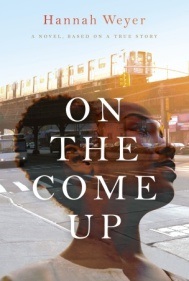 Over the next several months, Anna and I sat and talked. We collected hours of recorded interviews and it soon became clear that her fearlessness would become the dominant trait of the main character of On the Come Up. I decided to draw from several key events—the birth of her daughter, her role in Our Song, and her eventual departure from Far Rockaway—to structure the novel. Using these real events as signposts, I began to string together a fictional story about a girl's rite of passage, an odyssey from one place to another. In a world where dreams of escape are fed by endless stories of overnight success, celebrity, and stardom, sometimes the struggle is as simple as finding your way off the block. Fictionalizing opened up a personal space for me to bring my own musings to play. My creative interest in examining family structures, the function of boundaries, and the question of escape moved the story away from biography, and toward an imagining of a protagonist and a world in which these themes could be developed and explored. How did you master the urban language of the novel? Besides working on films and screenplays, each year for the past dozen years, I spend part of my time as a guest teaching artist or one-on-one mentor in high schools, after school programs, or for media arts youth organizations. Being around teenagers, I find it especially engaging to listen to how they joke and tease, to their particular phrasings or colloquialisms, how they disguise their feelings or fears, how they jostle to express themselves. I was also very much influenced by the interviews Anna and I made together, and it became clear, early on in the writing process, that it would be Anna's voice, and not my own, that would become my muse. What is it about AnnMarie that made her aspire beyond expectations—to go beyond the norm for those growing up in her isolated neighborhood? I really don't know where strength of character comes from. Are people born with backbone, with higher aspirations, or yearnings and curiosity? Or is strength of character something that can be nurtured, brought to play in a young person's life and made meaningful? I do know that I gave this quality to AnnMarie because I saw it in Anna Simpson, just as I've seen it in other teenagers I've spent time with over the years, young people who apply themselves, defy expectation, and prove beyond a doubt the usefulness of simple, daily conversation and contact between grown-ups and children at the cusp of adulthood. AnnMarie's story has fairytale elements—some might say that if it wasn't based on truth it would be too far-fetched. Yet, AnnMarie's struggles are realistic, even mundane. And her successes do not make over her life. How did you balance engaging storytelling and reality? Interesting thought. I might disagree though that AnnMarie's story is far-fetched. If you think about it, every day thousands of kids go on auditions for movies, for singing or dance competitions, or for reality TV contests, like American Idol or The X Factor. But we only hear about the success stories that make the news. AnnMarie's story is really about what happens before and after the audition, the movie premiere. She goes on with her life, enriched by the experience, but still faced with the challenges most people are up against: how do I find work, how do I make a stable home, how do I find happiness and love? Despite the fact that this novel is published for adults, do you have hopes or expectations for its success with teenagers? Yes! I think AnnMarie is a character that teenagers can relate to and will want to spend time with. What becomes clear as you sink into the story is that AnnMarie is just a regular kid. She likes music, wants love and friendship. She dreams. She has beefs with other kids, sometimes physical, sometimes verbal, and won't back down from a fight. She is at times naive, pig-headed, brash, single-minded, and yet she has this remarkable ability to be optimistic about life, a quality that helps her face down conflict and climb over spatial barriers, and keeps her asking questions about her place in the world. It's true she might have more drama than the average teenager but not by much—most kids have dealt with bullies at school or on the block, have encountered a domineering grownup who exacts control. Some have been pregnant or have friends who have become pregnant. Some have had boyfriends who have cheated and who have felt betrayed. I think On the Come Up is the kind of story teachers can bring into the classroom to share with their students. AnnMarie's story lends itself to discussions about class, identity, family histories, generational patterns, domestic abuse and/or the relationship between social isolation and violence in contemporary urban America. It's been my experience that young people can and will rise to the intellectual occasion when the material feels emotional and relevant, when characters appeal to them on some visceral or personal level. See the SLJ review of On the Come Up, published on the Adult Books 4 Teens blog.
Added To Cart
RELATED


RECOMMENDED
CAREERS
The job outlook in 2030: Librarians will be in demand
CAREERS
The job outlook in 2030: Librarians will be in demand
ALREADY A SUBSCRIBER? LOG IN
We are currently offering this content for free. Sign up now to activate your personal profile, where you can save articles for future viewing
ALREADY A SUBSCRIBER? LOG IN
Thank you for visiting.
We’ve noticed you are using a private browser. To continue, please log in or create an account.

Add Comment :-
Be the first reader to comment.
Comment Policy:
Comment should not be empty !!!