


2018 School Spending Survey Report
School, Public Library Collaborations Benefit Staff and Students
When school libraries are short on resources and staff, public libraries can provide a lifeline to increase students’ access to books and other library resources and bolster their love for reading.
 |
Getty Images: Dynamic Graphics (jugglers); miyuki (books) |
When school libraries are short on resources and staff, public libraries can provide a lifeline, partnering with school libraries or districts on everything from student library cards to book trivia competitions to increase students’ access to books and other library resources and bolster their love for reading.
“Our entire purpose is to come up with programs like this,” says Conni Strittmatter, youth and family engagement manager at Baltimore County Public Library (BCPL), which successfully partners with local schools in various ways.
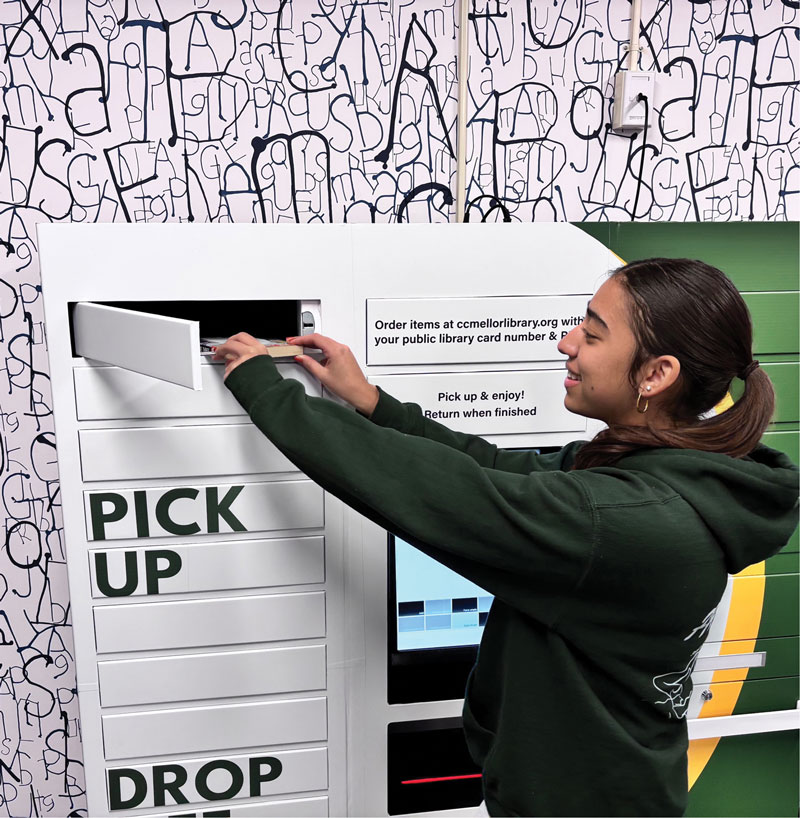 |
A student retrieves items from the book lockers provided
|
Increasing access
Kevin McGuire, library media specialist at Woodland Hills High School in Pittsburgh, said he and C.C. Mellor Memorial Library Director Erin Pierce first partnered to create library cards for all students. But obstacles, such as kids not living near a library branch, still existed, so a novel approach was needed. Now, the C.C. Mellor Memorial Library delivers materials to “book lockers” at the school library, and students scan their ID card to open the lockers and get their materials. The program fully launched in 2024.
“Without having left the school building, they’re able to access everything the [public] library has to offer,” says McGuire.
“Now that the kinks are worked out, I think that it’s going remarkably well,” Pierce said. Students can get materials the school library might not have, including board games and video games. Teachers are also using the system to get materials, “which wasn’t something that we necessarily expected, but we’re thrilled to see that happen.”
BCPL also offers student library cards, which it has done since 2017.
“All they need is their ID number and they’re able to access things like our databases from school, which is fantastic because we have different databases from the school system,” Strittmatter says. “Students can do research and the schools are able to point kids to those resources.”
The accounts are limited and don’t allow the library to contact students about missing items. But it’s “worth the loss, because we know that we’re increasing access at the same time,” she says.
About five years ago, BCPL also launched Library at Lunch in the middle and high schools.
“We know school libraries often have limited budgets as well as a really limited purchasing timeline, whereas we purchase daily, basically, so we can get the latest, hottest titles,” says Strittmatter. “So we bring these books in as well as promotion for other library services, [and] we sit at a table during the lunch period.”
The same librarians come back each month, “so they get to know the kids. They get to know what they read—we can see them interacting with the students when they check out,” says Amanda Lanza, coordinator of the office of library media and instructional technology at Baltimore County Public Schools.
Library at Lunch is a success, Strittmatter says. After it launches at a school, circulation on student accounts can increase 500 percent or more.
In Seattle, the Library Link program gives students access to the public library’s online resources, including ebooks, databases, and virtual tutoring. Darth Nielsen, assistant director for library engagement and experience at the Seattle Public Library (SPL), says, “All of us are interested in supporting student success at the school using school resources, and in the community when the school is not available.”
In fall 2025, SPL also launched a pilot program called SPL Story Squad. Teachers can request books for their curriculum to be checked out and delivered to their classrooms for up to a month. It is being tried at one elementary school.
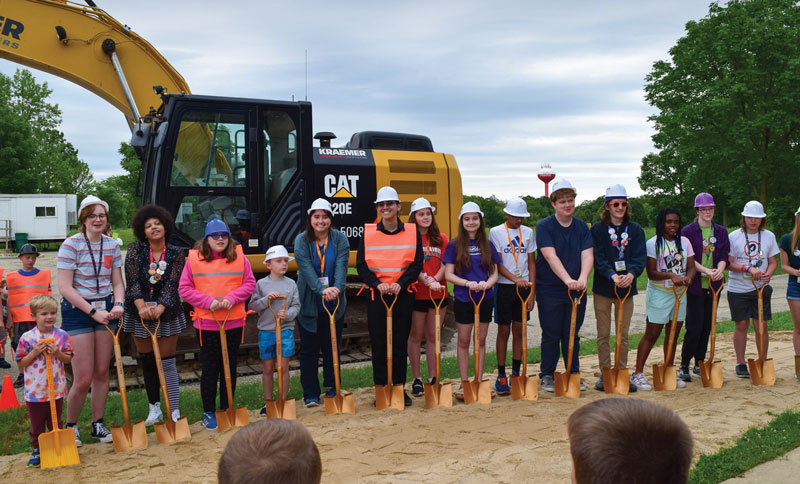 |
Sun Prarie VolunTeens at the groundbreaking for the library expansion and renovation.© Sun Prarie Public Library 2024
|
Book challenges and trivia
A longtime successful collaboration in Seattle is SPL’s Global Reading Challenge. Now in its 31st year, it started small and expanded to all 72 district schools, says Jenny Craig, Global Reading Challenge librarian. In November, the public library picks eight books and sends copies to student teams created by school librarians. After the teams read the books, they compete in several rounds of book trivia questions written by SPL librarians, with citywide finals in March.
Students get into the fun, Craig says, creating team names, dressing up, or bringing mascots. Some teams have their own cheering squad at the final.
SPL also arranges author talks during the competition. Afterward, it donates a classroom set of the selected books to the schools, usually about 9,500 books a year.
Craig says students broaden their reading habits after participating in the challenge.
“I’ve had a lot of parents talk about how this has completely changed their kid’s attitude toward reading.”
Between 3,200 and 3,500 students participate every year, she says, and because school libraries allow teams to hold practice sessions during lunch, “it changes friend groups as much as it changes reading enthusiasm.”
 |
Students in Baltimore create art in response to a book they read.Photo courtesy of Baltimore County Public Library |
Book trivia is popular in Baltimore as well. For the countywide Battle of the Books, teams in fourth and fifth grade, middle school, and high school read 10 nominees for the Black-Eyed Susan Book Award. In the spring, the public library holds a trivia competition for the younger grades, while high school participants create an artistic response to the book that spoke to them the most.
“Many of them will write a short story, a poem, maybe they’ll paint something,” says Strittmatter. “We’ve had winners that made a three-dimensional diorama sculpture.... We had a winner one time who animated a video and then she performed her spoken word poem over the top of the video.”
According to Lanza, Battle of the Books began in a few elementary schools and became so popular that the Teachers Association got it listed as an official extra duty activity so they can get paid to sponsor it. It now encompasses all of Baltimore County, including private schools and homeschooled students.
“Teachers have really bought into it, the kids really seem to enjoy it,” she says. “We obviously love it because it means that they’re tied directly to reading whole novels.”
All 19 branches of BCPL have at least one school participating, Strittmatter says, adding that they invite authors to do virtual or in-person talks with students as part of the program. “Kids are thrilled to meet the author of the book they’ve been reading and come with so many thoughtful questions.”
Bringing in students
The Sun Prairie Public Library in Wisconsin wanted more input and participation from teenagers in the community, so around 2022 it created two student trustee programs on its board, one from each high school.
“The current two students that are serving were longtime, robust library users,” says library director Svetha Hetzler.
The district’s school board has student trustees, so the library used that model as a guide. Student trustees are recruited though the library’s communication channels and word of mouth, and they receive a monthly stipend for attending board meetings.
“At the start of every meeting, the student trustees offer a brief report,” Hetzler says. “It could be something about the library, but it does not need to be. It might just be what activities are happening at their school, or what they’re hearing, or what they’d like to see, so that we can get their perspectives on things.”
The library is undergoing an expansion and renovation project, and Hetzler says the board was unsure about adding audiovisual studio spaces, since students already have that at school. The students said they did want those spaces at the library, since they might not have time to complete projects at school. “It’s just good to hear what their needs are,” she notes.
The library doesn’t have a formal teen advisory committee, but student patrons do offer suggestions, helping pick the furniture and layout for the new teen space, according to Hetzler.
Student trustees help library staff feel more connected to what’s going on in the schools, especially if they don’t have children in the district. The library established a community arts committee to look at artist-in-residency programs and art exhibits in the library. One of the student trustees is interested in art and is serving on that committee.
“I think they’re getting a lot of experiences and being able to share their voice,” Hetzler says.
In addition, the library runs a VolunTeens program. Teenage volunteers help operate the summer library program, working with younger children and helping with crafts, and work with the library on other events. Hetzler said this gives them a glimpse into engaging with the community.
BCPL also offers volunteer time to students, who are required to log a certain number of hours before graduation. For the Be Involved program, students come to the library and complete a community impact project. A recent project involved decorating baby blankets and packing newborn kits for a local hospital, which included a book, information about library services, and a note from the student.
The library has a partnership with the Baltimore school district called SAIL—Students Achieve in Libraries—which looks for ways to work together. Library staff and reading specialists attend one another’s professional development programs, “so that we can better serve each other but also better serve the kids and families in our community,” Strittmatter says.
Partnerships help school and public libraries reach the students they both serve. McGuire, the media specialist in Pittsburgh, says of the C.C. Mellor Memorial Library, “We have benefited so much from them, because they have provided so many things to us.”
Getting started
These librarians had one big piece of advice for school librarians looking to partner with their public libraries: Reach out and ask, and don’t be afraid to start small.
“Having a conversation, getting the right people together, is really that first step,” Lanza says.
She suggests learning which branch their students go to “and I would just make a visit. Go and talk to whatever librarians are there and just try to start a relationship.”
McGuire says it took years of brainstorming with Pierce to create the student IDs and then the book locker program in Pittsburgh. He suggests forming a relationship with someone in the community—if not a library, then a community center, bookstore, or other “third space.” “It all comes back to having that relationship with somebody.”
Many library systems have a youth coordinator or youth services manager to coordinate partnerships. BCPL has a memorandum of understanding (MOU) for certain programs, which Strittmatter says ensures a program will last. “The MOU means that both organizations are going to be revisiting this regularly and committing to it.”
Nielsen advises being mindful of security and privacy issues, especially when sharing technology, and make sure school and library policies are compatible.
Craig says, “One of the most helpful parts in my work is to remember that each school is its own ecosystem.... We always try to let the school tell us what they need and then respond appropriately to that.”
Just try asking, Hetzler says. “I don’t think a public library would ever say no, because we’re always looking to foster and advance more ways in which we can both mutually benefit each other.”
Marlaina Cockcroft is a freelance writer and editor.

Added To Cart
RELATED

RECOMMENDED
CAREERS
The job outlook in 2030: Librarians will be in demand
CAREERS
The job outlook in 2030: Librarians will be in demand
ALREADY A SUBSCRIBER? LOG IN
We are currently offering this content for free. Sign up now to activate your personal profile, where you can save articles for future viewing
ALREADY A SUBSCRIBER? LOG IN
Thank you for visiting.
We’ve noticed you are using a private browser. To continue, please log in or create an account.
Add Comment :-
Be the first reader to comment.
Comment Policy:
Comment should not be empty !!!